Chicken co-op
Hawaii have small islands and most of the chicken producers are very small scale. The number of birds of 1000-5000 are the bigger players, who are still not large farm. Small scale poultry producers can have a lot of barriers. Working collectively can help producers getting grants to purchase items that can be used collectively for common benefit. For example a poultry hatchery can be funded through a grant, all co-op members can run it to get day-old chicks hatched on island.
Other than that, the group can also purchase other items in bulk just to reduce the cost of items. For example Feed, egg crates, etc.
How to join?
Contact Prem Mahato, a junior extension agent, based at Hilo. Contact: pmahato@hawaii.edu; 808 969 8218
If you wish to join a group that is working on formation of poultry working group or a co-op then please feel free to join our next meeting. Most of the meetings are hosted monthly on the First Tuesday of each Month, or look for a flyer that can be found on the home page of this website.
Please register for next meeting. Meeting are in person, but if its far from you, please request a zoom link.
Fore more info contact Prem Mahato, a junior extension agent, based at Hilo. Contact: pmahato@hawaii.edu; 808 969 8218
Progress
There is a growing interest in joining a poultry co-op in Hawaii. As the state lacks any organized group on poultry, few farmers has shown the interest in joining the group. A survey sent in November 2024, gathered 55 interested people. So far we have been meeting once a month, and planning on continuing the meet. In our first meeting we invited Dr Rajesh Jha, and Dr. Rajeev Mishra as a resource person. They helped us understand poultry nutrition and disease. Prem Mahato (Extension Faculty at UH Manoa) act as facilitator of the program. The program is organized a potluck dinner.
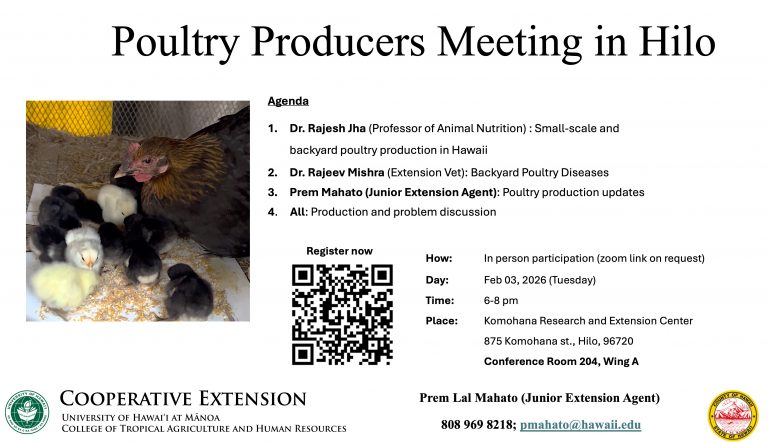
1st meeting (February 3rd, 2026)
In the very first meeting we identified the barriers in the poultry industry in Hawaii, which are listed below
Feed (Expensive?; Lower quality; inconsistent supply?)
Slaughterhouse (is it needed, is it different from other animal)
Market (Is it hard to sell; is it expensive than other imported?)
Professionals? (Vet, technicians; their expensive charges)
Diseases (Avian Influenza, Pox, Coccidiosis, etc. )
Day-old chicks (Availability, Import, Mortality)
We also discussed what could be potential efforts to reduce these barriers;
The group discussed and found out that we could do many things, which are listed below
Supply chicks (Locally) – sourcing (Breed and genetics)
Solves day-old chick shipping issue
Solves day-old chick shipping loss
Solution: Hatch our own (Through
Consistent availability of quality feed through collective bulk purchase through organized group
Alternative feed source (BSFL)
Working together as a co-op
Replicating other university ideas
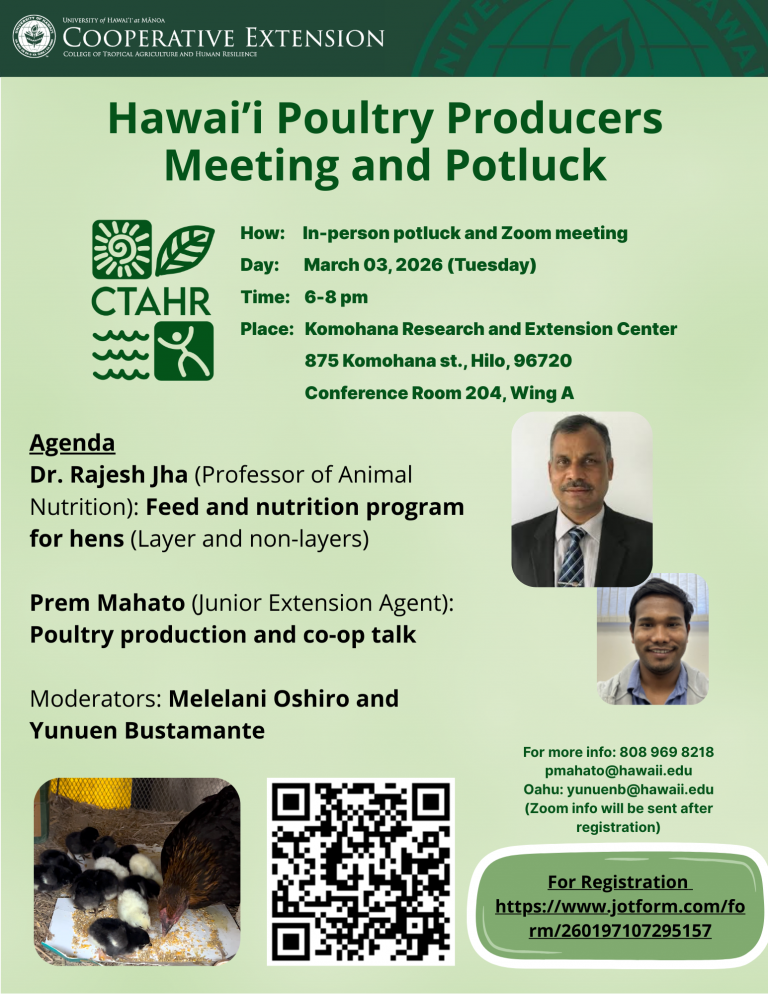
2nd Meeting (March 3rd, 2026)
Second meeting was organized in the same potluck style. Dr Rajesh Jha was the resource person who taught us about feeding the poultry. Other than that we had a volunteer Brittany Anderson we helped us understand what a successful poultry co-op in Hawaii would look like. We discussed whether we should start a co-op or do something else, majority agreed on starting a co-op. When asked what should be topic in 3rd meeting, the group demanded an expert on co-op, so for third meeting a co-op expert was invited to talk on April 07, 2026.
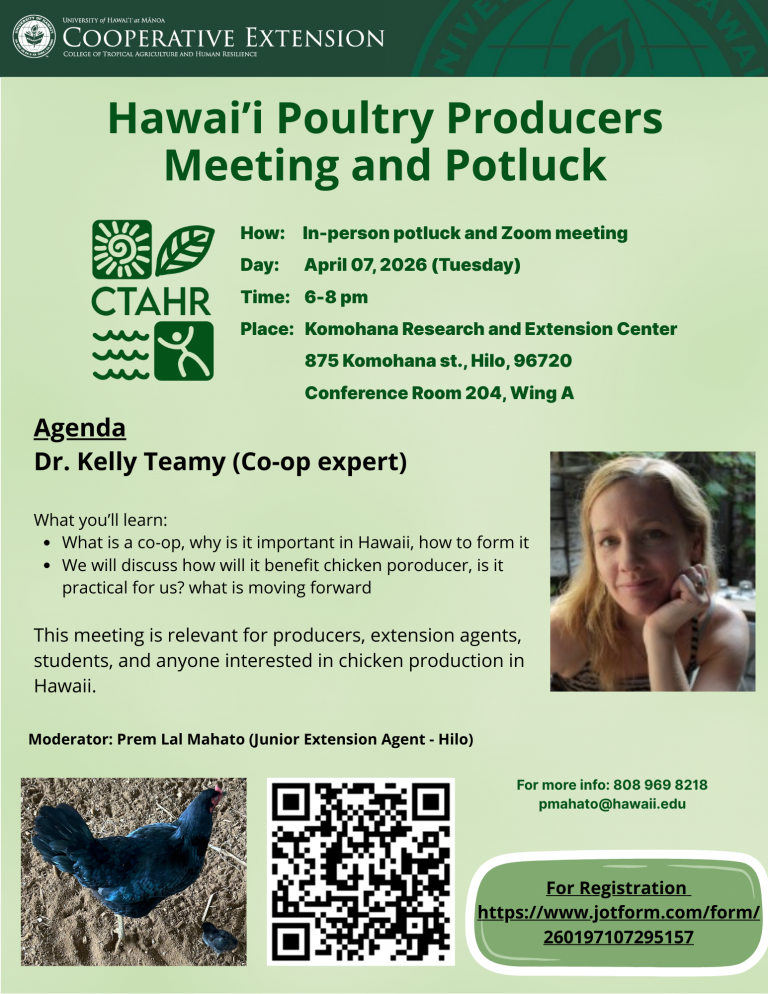
3rd meeting (April 07, 2026)
The meeting was recorded. And it is available for you to watch, please click here to access the video
Kelly Teamy was the resource person, who spoke about how do we start to form a co-op, what are the type, why do we need a co-op in Hawaii, who will benefit from it, etc.
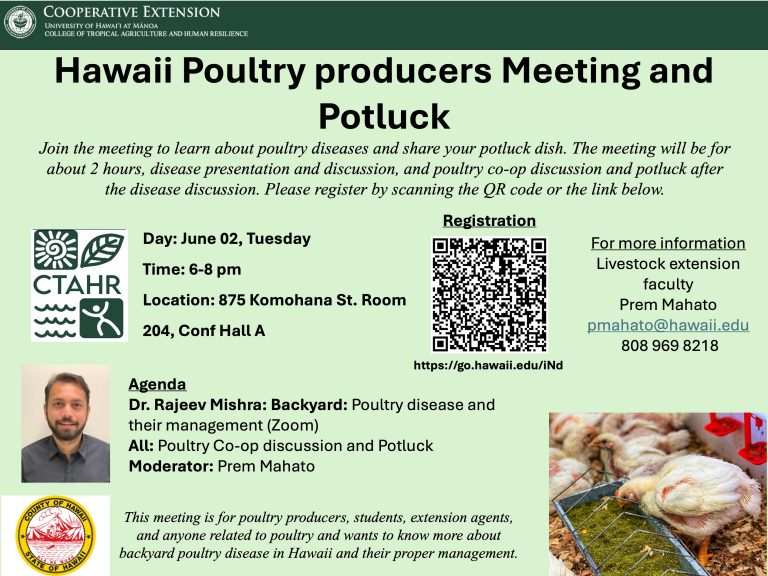
4th Meeting
The 4th meeting was on June 02, 2026. We skipped May meeting, and in the 4th meeting we had Dr. Rajeev Mishra talking on poultry disease, focused on the eye diseases. The recorded video is posted here (click here). The co-op discussion was about feasibility study, we discussed on Market viability, member viability. In our next meeting we will be continuing the meeting and go for financial viability, operational feasibility, and go/no go discussion.